
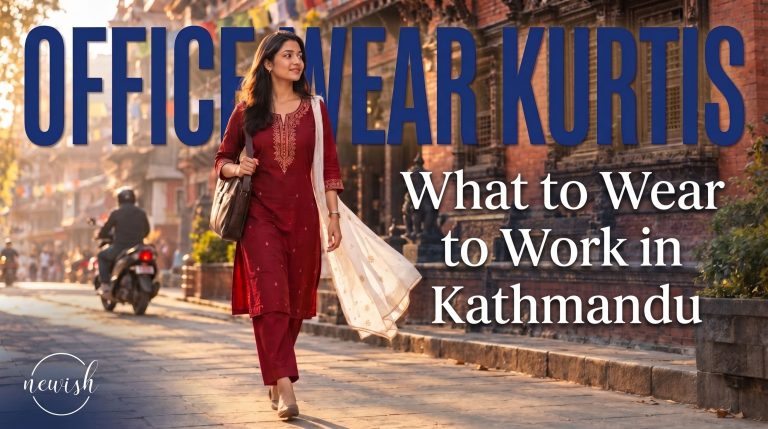
Getting dressed for work in Kathmandu is its own small puzzle. It’s cold when you leave the house and warm by lunch. Somewhere in between you’ve sat on a scooter, squeezed into a microbus, or walked a stretch of road that is mostly dust. Whatever you put on at eight has to still look decent at five.
That’s a big part of why so many women here wear kurtis to the office. They’re comfortable, nobody questions them in a meeting, and they forgive a rough commute.
Still, some kurtis look like work clothes and some look like you’re on your way to a cousin’s birthday. Here’s how to tell them apart, and how to get through a whole week on three of them.
What makes a kurti look “office”
Mostly it’s the fabric. Cotton, cotton-rayon, khadi and raw silk hang properly and stay that way until evening. Thin, shiny synthetics are the ones that give trouble. They cling, they show sweat, and under office tube lights they look like party wear.
After fabric, check the length. Knee length or a little longer works best, because it behaves when you sit down and when you climb to the third floor because the lift is out again.
Necklines are simple. Round, boat, a collar, or a V that isn’t deep. If you’d tug at it during a meeting, it’s the wrong one.
Prints are where most people go wrong. Small florals, thin stripes, block prints and plain solids all read as work clothes. Big motifs, mirror work and heavy gold embroidery are lovely, and they belong to Dashain, not to a Tuesday.
Last thing: leave yourself room. You’ll be in a chair for most of eight hours, and a straight or slightly A-line cut with side slits is far kinder than anything fitted.
It depends where you work
A bank or a corporate office is the strictest. If there’s a uniform, none of this applies and your mornings are simpler. If there isn’t, stick to solids or very quiet prints with matching straight pants.
NGOs, schools and colleges are easier. Cotton and khadi sets are everywhere, small prints are fine, and flat shoes are normal because you’re on your feet. The one thing to avoid is thin fabric with no lining, especially if you stand in front of a class.
Startups and agencies barely have rules. A short kurti over jeans is close to a uniform there, and bolder prints are fine.
Wherever you work, keep one serious kurti for the days you have a client meeting or a presentation. Raw silk or cotton-rayon in a deep plain colour does the job. Pure cotton is wonderful, but it will be creased by noon, and that’s the day you’ll mind.
Dressing for Kathmandu’s seasons
| When | What to wear | Worth knowing |
|---|---|---|
| March to June | Pure cotton or khadi in light colours | Banks and corporate offices run the AC cold, so keep a thin dupatta in your bag |
| June to September | Cotton-rayon in darker shades | It dries faster than pure cotton and hides splashes. Skip anything that touches the ground |
| October and November | Cotton or raw silk | It’s festival season, and nobody will blink at maroon or mustard |
| December to February | Heavier cotton or raw silk, layered | Most offices aren’t heated. Wear a thermal inner and a cardigan, and bring a shawl for the morning |
We’ve written more about how cotton and cotton-rayon differ in our post on cotton kurtis in Nepal.
Colours
If you only buy three work kurtis, make two of them boring. Grey, beige, off-white, navy, black, maroon and olive go with everything you own. Nobody remembers that you wore the grey one on Sunday and again on Wednesday.
Then add one colour you love, and wear it with plain bottoms and a plain dupatta. One loud thing per outfit is a good rule. A bright kurti with bright pants and a bright dupatta is a festival look.
Bottoms, dupatta and shoes
Straight pants look the sharpest. Leggings are fine under a long kurti and a bit much under a short one. Palazzos are the most comfortable thing you can wear at a desk and the most annoying thing on a scooter or a wet road, so check the sky first.
Whether you need a dupatta depends on the office. Plenty of workplaces don’t expect one any more. If you wear it, pin it at the shoulder. An unpinned dupatta and an office chair with wheels are a bad combination.
For shoes, closed flats, loafers or a low block heel. Sandals are fine until the first rain.
Getting there in one piece
On a scooter, or on the back of a Pathao, wear straight pants and a kurti with side slits. Tuck the dupatta in, or keep it in your bag until you arrive.
On a microbus you’ll be pressed against strangers for twenty minutes. Cotton-rayon and raw silk come out the other side with fewer creases than pure cotton.
On dusty or rainy days, wear dark bottoms and keep a spare scarf in your desk drawer. You’ll use it more often than you expect.
A full week from three kurtis
You need one neutral kurti, one printed and one in a deep colour, plus black pants and beige pants.
| Day | Outfit |
|---|---|
| Sunday | Neutral kurti, black pants |
| Monday | Printed kurti, beige pants |
| Tuesday | Deep-colour kurti, black pants, dupatta |
| Wednesday | Neutral kurti again, beige pants, a printed scarf |
| Thursday | Printed kurti, black pants, cardigan or blazer |
| Friday | Deep-colour kurti with jeans, if your office is relaxed on Fridays |
If your office runs Monday to Friday, start a day later.
A few from our shop
If you’re starting from zero, these are the ones we’d point you to.
- Grey Raw Silk Kurti Top, Rs 1,200. The one for meeting days.
- Black and White Cotton Kurti Top, Rs 1,200. Works with black or beige pants.
- Khadi Cotton Kurti Top, Rs 1,500. Good for the hot months.
- Light Brown Silk Kurti Top, Rs 1,200. A soft neutral for autumn.
- Off-White Floral Cotton Kurti Top, Rs 1,200. A small print for ordinary days.
- Pink and Maroon Cotton Kurti Set, Rs 2,500. A full set for when you want some colour.
The rest are in our kurti collection. Every product page lists the fabric and the sizes we have.
Making them last
Work kurtis get washed a lot, so treat them gently. Turn them inside out, use cold water, and dry them in the shade, because Kathmandu’s afternoon sun fades colour quickly. Iron on the reverse side if there’s a print or embroidery.
One more habit helps: hang tomorrow’s kurti on the door before you sleep. Half the creases drop out overnight, and you don’t have to decide anything at seven in the morning.
Quick answers
Is a kurti formal enough for an office in Nepal?
In most offices, yes. Pick a plain or lightly printed one in cotton, cotton-rayon or raw silk, and wear it with straight pants. If your workplace has a uniform, that comes first.
Can I wear a kurti with jeans to work?
In a relaxed office, go ahead. A short kurti with dark, plain jeans looks neat. In a bank or a corporate office, straight pants are safer.
How many kurtis do I need for work?
Three will get you through a week if they share a colour palette. Four gives you breathing room on laundry day.
Which fabric creases the least?
Cotton-rayon and raw silk. Pure cotton is the coolest in the heat, but it needs ironing.
Start with one grey, one print and one colour you like, and add to it when payday comes.
See the kurtis: newishfashion.com.np
If you’re also shopping for sarees or lehengas, our women’s clothing in Nepal guide compares all three.
Prices and stock change. Check each product page for the current details.